Thursday, August 22, 2024

Bad Spelling Mission 4 - The road to Paderborn

23/11/1983 Sov 3rd army forces BAOR fighting retreat into Ruhr cities. Bad Spelling is isolated behind the front line

The team has just returned with a sealed container from the supply dump where Major Lawrence expected it to be, which they suspect to be a battlefield-level nuclear device.  The major refers to it as the "beastie".  On return to base, the team meets two more stragglers to join them, one of whom immediately manages to injure himself and is sent straight to sickbay.

Also waiting to meet them is the mayor of Bad Spelling.  He has a request for the army, which is to find out whether the road is clear and safe for him to travel to Paderborn.  Major Lawrence decides to leave at once, taking advantage of darkness, pausing only to grab something to eat and to lock the "beastie" in a store cupboard.  His plan is to travel until we find an enemy checkpoint, then snatch one of the enemy on duty and bring him home for interrogation.

The Brits leave the Land Rover and proceed on foot

Stealth rules will apply, modified for OHSW.  The team will drive as far as they dare, but then leave the Land Rover and arrive on foot.

The enemy has a defensive position set up in the outskirts of Paderborn.  There is a PK MG (emplaced, on a tripod), with 2 additional crew (carrying AK-74s, but one acting as crewman/loader to the PK) and a sniper. The second squaddie (patrolling) and the sniper will be up to 12" from the MG position.

The soviet checkpoint

Stealth: until the attacking player is detected, only the patrol figures may move (1d6-2" in a random direction) and no shooting is permitted.

Any attacker within 6" and in LoS is detected automatically unless moving into contact and defeating the defender in HTH (assumed silently).

For attackers within 4" but not in LoS, or in LoS but >6" away, check for detection: defender draws 1 card, attacker 2.  If defender has the highest card, check the colour of defender's card: black=alert (move defender 2" closer and check again), red=detected (alarm is raised, no more stealth).

The edge of town

As mentioned last time, this is (I hope) the lowest point for scenery in this series, with cardboard boxes standing in for buildings.

Most of the table didn't get used, so you can ignore the medical centre at bottom left, the chapel and the park.  The action is concentrated around the checkpoint (top right corner of the square).

To the right of the checkpoint, the Brits are moving around a large, brown building (council offices), with Newton to the left.  Beyond them, a minibus of some kind is parked outside an office building at the back (the "back office" mentioned later).  At top centre, behind the MG position, another building faces the "back office", with the soviet transport parked between the two.

At this moment, the Soviet sniper is just behind the MG emplacement, while the patrolling soldier is at the left of the square, having walked across to check on the park.


The Brits begin to approach. The Russian patrol walks back to check on the sniper behind the truck (guarding the rear), then up to the MG position. The Brits take up positions behind the council office, waiting to see what the patrol will do next

The patrol walks around in the square.  Newton contemplates a dash straight across the MG's fire-lane to cover behind the white-roofed building.  The patrol's back is turned and the MG crew won't step forward on an alert.  He decides to go for it and ... turns up a joker.  A noise in the distance makes everyone turn, including Newton, who quickly ducks back into cover.  The turn ends.


The patrol turns and starts back toward the MG position.  The Brits hold their breath.  Passing the MG, the patrol checks on the truck.  Fraser gets in position to dash past the side of the MG

The patrol checks on the sniper.  Fraser backs off, so he won't be seen if the patrol turns back.

Fraser takes cover at the corner

The patrol turns!

Fraser slips back into position.  The patrol moves to check on the truck & Fraser takes his chance.  He rushes across the street and down the side of the back office.

The back office, Fraser and the patrol

The patrol walks around the corner behind the back office, up to 5" from Fraser, but immediately turns back to rejoin the sniper.  So close!

The patrol turns around and takes another look behind the back office.  Fraser rushes him! The patrol wins the fight - Fraser is down!

Although the Brits have 8 more action points, initiative switches immediately to the Russians.


Ten seconds of violence

The patrol and sniper move forward to engage the Brits - the MG team holds position.  The patrol shoots at the Major, but misses.

The Major throws a grenade.  The sniper is down, but the patrol is saved by the wall

Dangerous runs forward behind a car and starts firing on the patrol. The patrol fires back.

The Major steps out of cover and throws the other grenade into the MG position.  Both the crew go down.  Davies shoots the patrol and puts him down.

Newton moves toward the rest of the team.  Lawrence & Davies secure all 4 Russians. Game over.  The team secure all 4 men from the checkpoint and hurry away, stealing the truck as well as taking their own Land Rover (because you can't fit 4 prisoners in a Landie).

Scenario design: this was stealthy and stressful.  Fraser's bungled grab at the patrolling sentry felt like the objective was lost, but the use of both grenades saved the day.

After the fight: 

  • The Brits have achieved their objective.
  • Fraser is lightly wounded and will be out of action for 6 days
  • 4 prisoners taken.

Reinforcements: One figure with L1A1 SLR, one with pistol - Pvt Oliver & Capt Preson have found their way to the base at Bad Spelling.

Specialist gear: medical kit (Re-draw one card to recover from a knock-down)

Skill gain: Newton gains Charisma

Group morale: 5 - rolled 7 good and 1 bad dice, scoring 2 increase

Campaign events: 

  • Pvt Oliver reveals that he is actually on his way to take leave, and will be gone for 9 days.  Like Paddy O'Loughlin in sickbay, he has no sooner joined us than leaving us again. Maybe we'll see him on the 2nd of December, unless he joins some other unit.
  • No break - no time passes in the campaign before the next mission is assigned.  Hopefully there will be time for breakfast, but that may depend on what action comes next.

Player action: add another man to the group - Pvt Richards

The team is now strangely top-heavy, Major Lawrence & Captain Preston leading privates Davies, Newton & Richards.

Meanwhile Edwards, Fraser, Harris, Mitchell & O'Loughlin are recovering from injuries and Oliver is on leave.

People the team knows:

  • Lotte Meierling, a refugee from Hannover
  • Dieter Pletternberg, mayor of Bad Spelling

Until next time, health & happiness to you all.

Friday, August 16, 2024

Fighting Talk #2 - Skirmish games vs proper battles

Another source of friction in the hobby is the preference for skirmish games or large battles.

A skirmish, Amazons against Egyptians

Skirmish games are nothing new.  In the sense that one model represents one man, some of the oldest rules like Little Wars are skirmish games.  The men move on individual bases and single models are removed as casualties.  Featherstone's War Games describes 20 models as a regiment, but in all other ways those rules provide a skirmish game.  This style of game is suited to the close actions that probably don't make it into the history books: raids on supplies, a clash between patrols etc..  In terms of numbers, it becomes cumbersome to handle more than about fifty individual models per player, although Featherstone seemed happy with 150 or so.  The Too Fat Lardies describe some of their rulesets as "large skirmish" to distinguish this size of man-to-man fighting from small skirmishes between a dozen men in total.  At the upper end Charlie Don't Surf expects a full company on the table, so around 150 men and vehicles.

One corner of a battle, regiments contesting a road junction

The battle game also has a long history, going back to the 19th Century Kriegspiel.  Here the focus is on the behaviour of "units" at whatever level they would act independently on the battlefield, for example Napoleonic battalions.  The ground scale is key, with a battlefield maybe 3 miles wide on a six foot table (that's 880 yards of the field in 12 inches of the table), so that a battalion frontage of 100 yards would be around an inch and a quarter on the table.  Movement distance and range for shooting are all dependent on the ground scale and the length of a turn; how many turns should a battle take to play out, assuming it lasted maybe 8 or 12 hours of a day?  Classic kriegspiel used wooden blocks for the units, but a base with figures on top does the same job, although there won't be as many models as the men in a battalion.  This is the basis of Charles Grant's The War Game or John Tunstill's rules.

There are pros and cons to any approach.  The small skirmish needs few models and can cope with more complexity and detail in the rules and procedures, but will never reflect a conflict of historical significance.  It also tends to create mixed forces at an unrealistically low level: if the 23rd Foot sends the light company to take an objective, that would be dozens of infantrymen dressed and equipped identically; they would not send four light bobs mixed with one cavalryman and two highlanders.  Kelly's Heroes and Sharpe are works of fiction.

A large skirmish, American rebels forming up for a fight

The large skirmish needs bigger forces and risks a game that runs out of time before achieving a result.  To represent a significant battle using individual men would quickly become unmanageable.  Using one model to represent 20 or more men in the field is no longer a true (man-for-man) skirmish, and is better considered as a type of battle game.

The groundscale approach can only fit a relatively small number of models onto a unit's base, leading to taunts of "twelve men taking a flag for a walk".  More confusing is the model of a farm building, which is 4 inches wide and so represents 300 yards on the table and a small village.

Of course there is an option that allows a large action to be represented in a more realistic way, and I have played a few games in a sports hall or similar space which were great experiences, but the effort to prepare them was huge and the game has to finish within a day so the badminton players can use the hall.

Some rules sit in a middle ground, leading to a more confused experience.  Sharpe Practice, for example, allows 24 men to form square.  If that means that the 24 models each represents 40 men, then that's a battalion, which makes sense in square formation, but then how can a single sniper hit 40 men with one bullet?  Is that senior officer accompanied by 39 orderlies and gallopers?

In my own case, I play lots of skirmish games (many described on this blog) and also proper battles mostly as boardgames.  I'm currently collecting forces for battle games with models in a couple of periods.

The discussion boards show some highly polarised opinions on these three approaches. What kind of game do you play, or do you prefer a mixture?

Until next time, health & happiness to you all.

Monday, August 5, 2024

What happened there?

Suddenly it's a month since my last post.  What happened there?

Nothing much, just the typical mix of computer trouble (all fixed now, I hope), health problems around the family, and being distracted by other things.  Mostly trivial stuff like having some posts written but not being able to find the right images to go with them.

My usual opponent has been away on holiday, the D&D campaign has missed a few weeks because people were busy doing other things, all that stuff.

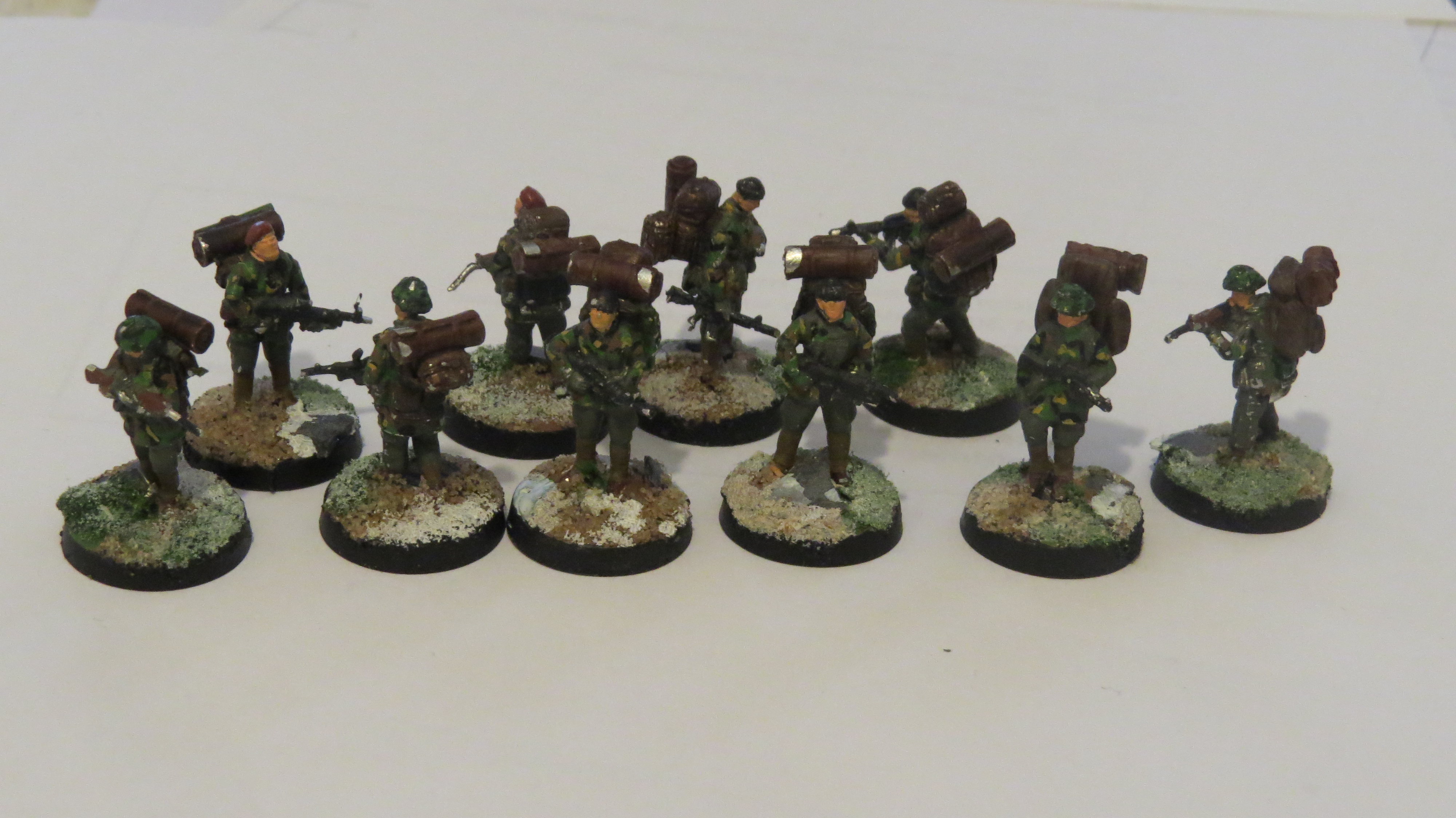
I bought a dozen Falklands-era troops to add to my Bad Spelling crew.  I didn't recognise the models, but they were already painted and a good price.  Sadly the seller just slipped them into a snappy bag and popped that in a box with some bubble wrap.  They turn out to be metal figures, probably TQD from Checkpoint Models, and they rattled around in the bag and lost quite a bit of paint.  Also a few gun barrels needed to be straightened.  So I spent a while retouching the shiny bare metal patches.

New recruits for June/July

Then I decided to get a game on the table, but just needed to move a couple of boxes of models to get at the ones I wanted.  Crash they went down onto the floor.  Tick off another day for repairs.

At least I've got in some cycling and a couple of games of Squad Leader.

Until next time, health & happiness to you all.

Wednesday, July 10, 2024

100 Page views


OK this is definitely tongue-in-cheek, because it's not much of an achievement, but I've seen other bloggers celebrate milestones in how many people their blogs have reached, so it seemed polite to do the same.  Of course one hundred page views is setting the bar pretty low, but it's a start.

There are obvious strategies to increase page views by engagement with other bloggers: following other bloggers and pointing out that they could come and read your new blog, for example.  Although that assumes that engagement and page views, comments etc are the purpose of the blog.  Suddenly we find ourselves in murky waters: why do you want to write a blog?  Do you crave interaction? Validation?  Attention?  Why not just start a Facebook page with photographs of kittens asking for cheeseburgers?

I want a place to record the events of my life (at least, some of them, the toys and games) in a way that will be easy for me to read them in the future.  I already keep a record of my games, and take photographs, but they aren't combined into an illustrated description with tags for searching.  That's what the blog gives me.  And because it's public, other people get the chance to read my diary and comment on it, but that's definitely secondary.  Thanks to all 3 of my regular readers for taking a look.

Back when I was a computer programmer, a wise colleague told me that the point of putting comments in the code was so that it could be understood by strangers who don't understand how it works, which includes yourself a couple of years from now.  Here's something I can read that will remind me what happened and what went well or badly in a couple of years from now, when I will have forgotten.

Until next time, health & happiness to you all.

Thursday, July 4, 2024

Bad Spelling chapter 3 - Grab the nuke

23/11/1983 Sov 3rd army forces BAOR fighting retreat into Ruhr cities. Bad Spelling is isolated behind the front line.

Maj Lawrence needs the team to pick up the item that he was being interrogated about. It's in a supply depot, he doesn't know which building precisely, or it may still be loaded on a lorry.  Not a stealth job, just get in and grab it.  (I couldn't have made it up.  The team rolled a follow-up mission at an intact building to Retrieve something).

The enemy has two sentries with Skorpion SMGs on duty (rather an odd choice by the dice), ready to call out a guard detail of an officer (pistol), a sniper (rifle), two guards with AK-74 and one with an AK-74 plus grenade launcher.

Motivation: 2 (chosen on the basis of campaign history) these are secondary units in an accidental meeting, not here for a fight

OHSW rules

For OHSW I re-wrote the sentry rules from 5MIN.  Each turn that the sentries have seen the enemy, after checking army morale, the WP draws a resolution card and adds the value to a cumulative total.  When the total is at least 15 the rest of the patrol arrives at a random board edge.

Searching the buildings for the objective is just like searching for the holy cross on p33 of OHSW, but succeeds on any face card draw (because it's not small or easy to conceal).

The team probably needs to steal a truck to transport it away.

I'd like to implement a proper solo system for this campaign, to make decisions for the opposition (which I only need because I'm using OHSW on table).

Each enemy figure has a "role" like sentry / patrol, shooter, brawler, officer etc. and a set of waypoint markers to follow.

Then a prioritised list of situations + actions drives how the enemy uses its activations, e.g. Shooter/Artillery with opponent within 6" should move away from the opponent. Conflict of Heroes has this approach, using a deck of cards that with a prioritised list of conditions & actions, drawing a fresh card so that the priorities are not the same every turn.

I could also use the troop classes in Hordes of the Things to suggest some behaviour types: Special Forces (Heroes), Tanks (Knights), APC (Riders), Brawlers (Blades), Shooters & Artillery.  I'll use this game to generate some possible action-rules.

Anyone of a nervous disposition when it comes to unpainted models or scenery should probably skip the rest of this report.  I'm working on some pieces in this area, but the aesthetics of the table top are liable to get worse before they get better.  Mea maxima culpa.

The supply depot

The supply depot is next to a main road (top of the photo).  The guard house is next to the main gate, with various storage sheds to the right and a line of shipping containers to the left.  A few vehicles are scattered around the central paved area.  A back gate at the bottom right of the picture gives access to a footpath. The Brits arrive on the road in the top-right corner.

The WP draw a joker for initiative - end of turn 1.

The Brits get initiative again, but this time they draw a Joker for actions in the phase - end of another turn and nothing has happened yet.

still guarding the front gate

The WP acts at last.  One sentry sets off to patrol the perimeter anti-clockwise, while the other one would like to go overwatch, but that's not available in these rules, so he just waits. Given no other use for actions, the patrolling sentry moves 3 times.

The Brits advance along the perimeter fence, remaining hidden for as long as possible.

By the time the Brits jump out and start shooting up the gate guard, his companion is patrolling on the far side of the compound.

"Eddie" & Fraser step out across the road and open fire.  Both miss.

The gate guard hits Eddie, while his mate starts running back across the compound. The Clock card is 10, so it will probably only need one more card for the rest of the WP force to be called in.

Fraser hits the gate guard.  Mitch runs up to finish him off.

front gate clear

Dangerous & the Major move up.  The patrolling sentry runs across the yard and fires a 2-shot burst at Mitch.  The first one misses, but the second gets him. The Clock advances to 12.

Fraser & Dangerous both miss & the patrol guy misses Dangerous.  The Clock card is a Joker, so the turn ends with the clock stuck on 12.  Both Eddie & Mitch are out of this fight and won't be getting up by themselves.

The patrol sentry moves in closer and shoots at Dangerous - another man down!

Fraser fires back but misses. Major Lawrence rushes in and tackles the guard, taking him out.  The Brits can now spend the rest of the turn searching freely...


The Major checks two trucks (no luck) and has moved on to the 3rd when Fraser calls out a find in one of the shipping containers.  Maj Lawrence gets in the truck & drives it to the container.  Fraser loads the case onto the truck.

Lawrence drives out of the gate, waiting next to the downed Davies.  Fraser gets out to cover him and drags Eddie on board.  Fraser drags Mitch into the lorry (another 4 AP) & also Davies.  With all the casualties on board, Lawrence drives away - their fate can be resolved when we get them back to Bad Spelling.  Dangerous recovers in the back of the lorry.

Scenario design: during Turn 3 the clock was advancing at the end of each phase.  That's excessive with a target of only 15.  However, when I noticed and reverted to my proposed rule (advance the clock at the end of a Turn), the game was over before another turn ended.  The other guards never arrived.

Also, it would make sense to have 2 men carry the device, but how should the Actions work in OHSW?  Should Each man spend 1 action to pick up an end of the case, and then they jointly spend 1 Action to move (like a crewed weapon)?

The Brits had plenty of spare actions available for the Major to jump out of the truck and help Fraser to load the device on board, so it didn't affect the outcome.


General rule system: I allowed Fraser to carry the device and his downed mates with no noticeable movement penalty (although a 3" move would have made no difference), and did not require an Action to pick them up or put them down.  Given the number of actions available to the Brits in Turn 4, this made no difference, but it should probably take an action to pick things up (dropping them is free).

The ability to load Down or Out men onto transport is something I just improvised, but it makes sense if one side is able to leave the field without needing to eliminate all of the other side.

Overall balance was adequate, giving a tense scenario and 3 men down in the final turn.  Lawrence forgot to be inspiring, e.g. to re-draw the downed men going out of action.

There were no obvious moments when I had to think about action-rules to decide what the WP would do, but I guess these applied:

  • Sentry sees enemy: converts to Brawler or Shooter (depending on weapon carried)
  • Shooter with target in range and Line of Sight: shoot
  • Shooter with no enemy in range: close range to nearest enemy
  • Brawler: close range to nearest enemy
  • Sentry: move toward next patrol waypoint

After the fight: 

  • The Brits have achieved their objective.
  • Edwards is lightly wounded (and will be out for 6 days
  • Mitchell is also lightly wounded and will be out for 10 days
  • The fate of the 2 sentries is not known.
  • No prisoners were taken.
  • Harris is already wounded and out of action until 6/12/83

Reinforcements: Two figures with L1A1 SLR, one with pistol - privates Newton & O'Loughlin arrive, perhaps stragglers from some unit nearer the front.

Specialist gear: temporary replacement weapon - O'Loughlin has a Minimi for the next mission

Skill gain: Fraser gains Scout(1)

Campaign events: 

  • Paddy O'Loughlin has an accident within minutes of arriving on the base & is out of action for 3 days (until 26/11/83). Maybe Lotte will visit him in sick bay?
  • Intense fighting - we are straight back in action.  No impact on morale (already rolled).
  • The minimi is broken; the burst that hit Green also put a round into the firing mechanism.

Player action: meet a new character (rolled a political figure) - the local mayor, Dieter Pletternberg

Group morale: 3 - rolled 3 good and 2 bad dice, scoring 1 increase

People the team knows:

  • Lotte Meierling, a refugee from Hannover
  • Dieter Pletternberg, mayor of Bad Spelling


Monday, July 1, 2024

Second quarter reading

Another quarter ends, and it turns out I've managed to read a book or two.  In some ways, this is quite a surprise, because I've been busy in other ways this quarter.  I managed to meet my target for cycling distance over the quarter and I've been on holiday.

Connie Willis - To Say Nothing of the Dog

Warning: this book contains time travel.  I mention this because it is enough to guarantee that my wife won't look at it (although she did watch "It's About Time" with me and appeared to enjoy it).  Two time-travelling characters from the future accidentally alter the course of history by causing the wrong couples to fall in love, and must then arrange for them to reorganise themselves in their historical pairings.  It's rather like a week at a country house with Jeeves & Wooster except that if they fail, instead of Bertie having to marry Madeleine Bassett, the future will be altered and Bertie may no longer exist.

The book makes several references to Three Men in a Boat (including the title, of course), as well as Alice in Wonderland and Through the Looking-Glass, which should attract knowing smiles from readers who recognise them.  I can't say how much of the enjoyment is lost if you haven't read those two books, but if you haven't I advise to drop whatever you're reading currently and read both of those two immediately.  The tone and language in the historical sections were well done, and it made for a fine holiday read.

I mention the language because this book contains the word "doffed", which sets my teeth on edge (since I am by nature an Edwardian out of time).  The verbs to don and to doff are contractions of to do on or to do off, dating from the 14th century.  These days we might take off an overcoat and put on a dressing gown, but back then they would do off the coat and do on the gown.  This was shortened to doff the coat and don the gown.  All fine, but if someone did off a coat before doing on a gown there would be no contraction to "doffed" or "donning".  I was taught this at school (in a different century).  These days "doffed" appears in Merriam-Webster but Tolkien used the older style in The Return of the King when Aragorn “did off the star of Elendil”.  This style may be obsolescent now, but would have been standard usage in 1888. See also https://en.wiktionary.org/wiki/do_off and https://arnoldzwicky.org/2013/07/17/surprising-etymologies/

I don't think of myself as pedantic, but the more you learn the more it hurts to hear someone else get it wrong. And since that's my only complaint about the book, this can be considered a strong recommendation.

Bill Bryson - Shakespeare

It is unusual for non-fiction to be laugh-out-loud funny, but Bryson managed several solid laughs in this volume.  Perhaps he has an easy target, since so little is certain about Shakespeare and therefore so many wild theories have been produced with no supporting evidence.  We know almost nothing about Shakespeare's life (not even how he spelled his name), and the little that is properly documented, such as his will, raises more questions than it answers (such as why the only thing he left to his wife was their second-best bed).  Even our record of the plays is incomplete and contradictory between the different printed versions from an age when the typesetter might change a few words because he thought they looked wrong.  

Beside Shakespeare himself the book provides background on the theatre in his time and the political and religious turmoil through which he lived. Bryson also describes the suggestions that someone else wrote the plays and ridicules the lack of evidence for them.

At the end of the book we may not have learned much about Shakespeare, but we may understand that there is not much more to learn with any certainty.  Someone almost certainly called Shakespeare and from Stratford wrote a body of plays which is still admired today. The text was edited for each performance, for example to reduce Hamlet to the length of a feature film, and the version we have now may not be one that was ever staged; it may be like the special edition DVD with all the deleted scenes and bonus features.  But does that matter?

Bryson's other book "Mother Tongue" has a fascinating chapter on Shakespeare's legacy for the English language.  Here it is reduced to two pages, but still conveys the message of how many commonplace words and phrases in modern English were first seen in writing when Shakespeare used them.  Now I need to find an equivalent review of Milton's legacy, which looks to be almost as substantial.

Ali Hazelwood - Love on the Brain

I enjoyed The Love Hypothesis, the story of a female graduate student's awkward relationship with the most unfriendly man in the world, which turns out to be caused by mutual misunderstandings that resolve into romance.  So I read this next volume, which turns out not to be a sequel but a completely separate story about a female PHD researcher's awkward relationship with the most unfriendly man in the world, which turns out to be caused by mutual misunderstandings that resolve into romance.  There are differences between the two books, and on balance I prefer the other plot elements in this one than the first, so I recommend it as the one to read if you don't feel the need to read both.

Neal Stephenson - Anathem


And so we come to something of substance, weighing in at almost a thousand pages in paperback and using so many new words that it includes dictionary entries to let you read it.  Imagine a world where monasteries are isolated communities that preserve knowledge and advance study but with no religious connection, somewhere between a monastery and a university.  This is the story of a group of junior students, aged around 18. Like The Lord of the Rings, it begins with the little adventures of little people, being late for a lecture, getting into scrapes, dodging the authorities, and grows into a world-spanning adventure and beyond.

Along the way it has philosophical dialogues reminiscent of Plato, futuristic technology, very old technology, quantum mechanics and space travel.  It's difficult to say more without giving away the story line.  So much of what is happening does not become apparent until at least half-way through the book and some of the big themes are even later.

Unlike Stephenson's other big novels it barely mentions cryptography, and has no reference to Qwghlm, which is a plus for me.  Sadly there was a little bit of donning and doffing, but it is excusable in the context.  Like the almost-Latin or almost-Greek terminology for what happens inside the precinct of the monastery.

There is definitely some science fiction in there, but it's quite difficult to spot which items are speculative, unproven or just plain fantasy in such a rich mixture of real science, logic and philosophy.  The wikipedia article [https://en.wikipedia.org/wiki/Anathem] explains, but is full of spoilers, so don't read it until after the book itself.


Saturday, June 29, 2024

D&D campaign milestone

The weekly D&D campaign came to a dramatic milestone this week.  I don't normally post about it, but this was a significant event in the campaign and the action surprised everyone (DM and players alike), so it seems worth a mention.

Back in April of 2020 Darrell, our forever DM since we were students, offered to start a new campaign to help take our minds off COVID and lockdown.  This started by email, but soon moved to a weekly Zoom session.  In four years our party of uninspiring new recruits has been chased around a continent by every kind of opponent that was always too much for us to deal with.  We have become experts in running away from danger, whether it be armies of elves or lizardmen, invisible doppelgangers, vampires, wild baboon-elf-things that live in the forests or just being wanted for treason in all the human kingdoms.  You name it, we've run away from it.  When cornered, we fought fiercely and as a result have now reached 8th level (or 6/6 for the crazy hobbit twins).

Although hardly a force to be reckoned with in global politics, we have become capable of carrying out side missions for any faction that isn't actively trying to kill us.

So we come to this week.  When the elves invaded, one of their priestesses captured the heir of the human kingdoms and has kept him brainwashed by spells, thus creating a civil war within the humans.  As a result of some errands we ran for the temple of the Wild, we have the antidote to free him.  We have also recently discovered where they both are.  Now we just need a cunning plan to get in and rescue the rightful king.  We spent a couple of sessions planning this raid like Ocean's 11, except with more improvisation and a few problems we'll have to work out later.

It's late evening.  We arrive at the back door to the elven temple, having studied the plans of the place.  We expect the priestess to be off duty and in her quarters.  We knock on the door and demand entrance in the name of the Empress, showing off some orders that we carefully faked in advance.  The temple guards are convinced and escort us to her private rooms.  She comes out of her room, human heir in tow, to hear what the Empress wants of her.  Given the classified information, the guards are sent away to the next room.  Everything up to this point went perfectly to plan.  Then our spokesman Joshua decides to pick a fight with her over some point of etiquette, and a tense silence falls over the room.  Next thing, she calls out for the guards to get back in there.

As if he'd been expecting this, which of course was exactly what he expected, Francis steps forward and punches her on the jaw.  Garaf throws a Hold Person spell and to everyone's surprise the priestess fails her save.  Thirson uses a monk open-hand attack at the human heir, which leaves him stunned.  In two rounds of action, the opposition is out of the fight and the guards have not yet arrived.  We couldn't believe it, but we grabbed the heir and ran down the back stairs as fast as we could go.

Darrell had expected maybe three sessions of action in the temple.  Some sneaking, some fast talk and persuasion, some fights.  Instead, within half a session, we'd left the temple, magically locking the doors behind us, and were away to safety, all thanks to a ridiculous run of lucky dice.  The rightful king claimed his throne, dropped the charges of treason against us and by royal charter made us agents of the crown.

The arrival of the new king is the start of a new chapter in the campaign.  The political balance across the whole continent has changed.  We can now get to cities where we used to have a price on our heads.  We're still not capable of standing up to the real powerful characters, unless like this week we manage to get them alone and we are astoundingly lucky.  Now we just have to round up a legendary set of lost artifacts and use them to defeat the vampire lord, and then maybe we'll have to choose our own agenda for a change.

I know this stuff isn't everyone's cup of tea, but this week's session was a fitting conclusion to several plot threads, some of which started three years ago.

Until next time, health & happiness to you all.

Two crimes in one

 A grim tale for Christmas. My daughter wanted an Amazon gift card for Christmas, so we bought her one at a supermarket. Just before this, s...